On GHK-Cu. Read →

Pepoderma

AHK-Cu

Copper peptide AHK

≥ 99.0%CAS (complex, confirm with QA)Hair & Scalp

Overview

On a scalp-serum INCI deck this active reads as a copper peptide built on the Ala-His-Lys sequence — the AHK cousin of GHK-Cu, swapping the glycine at position one for alanine and shifting the molecule's working address from the dermis to the follicle. For a brand that has already shipped a GHK-Cu launch, AHK-Cu is the answer when the next product needs to talk about hair density or post-procedure follicular recovery rather than fine lines. The blue powder still signals intact Cu(II) coordination at a glance; the storyline on the bottle is hair, not skin. Pepoderma writes the AHK-Cu spec for chemists building leave-on scalp serums and recovery tonics. Use level sits in the 0.1–1.0% window on finished-product mass — the low end for daily-wear tonics, the high end for weekly intensive ampoules. The carrier should be chelator-free (no EDTA, no aggressive AHA loading) and hold pH 5.0–6.5 on copper-clean process water, with reductive antioxidants routed to a separate polarity layer. Non-ionic and anionic emulsifier systems behave; cationic conditioning bases pull the copper off-peptide inside hours and turn the formula colourless, so any leave-in programme needs a compatibility screen first. Sample fills follow the brand-build cycle: 20 mg for first-pass iterations, 50 mg once a carrier is selected. Each shipment carries INCI documentation, an allergen and trace-impurity sheet for CPNP, and a formulation-notes card that picks up where the GHK-Cu card stopped.

Who buys this, and why

Hair-and-scalp peptide actives — AHK-Cu in particular — ship to indie hair-care brand founders, scalp-care specialist labs, and clinical-aesthetic OEMs developing post-procedure scalp serums. The chemistry is closely related to anti-aging Cu-peptides but the carriers differ: scalp formulations more often use ethanol / propylene-glycol / glycerin blends, which require attention to copper-peptide stability in the chosen carrier. The lot report carries carrier-stability flags so the formulator can pre-empt the most common failure modes.

Primary buyer fit: medical-aesthetic brand R&D + back-bar retail OEM.

Specifications

CAS
(complex, confirm with QA)
Sequence
AHK
Purity (HPLC)
≥ 99.0%
Common vial sizes
20 mg, 50 mg
MOQ
On request
Lead time
10–18 days
Storage
Refrigerated, protect from light

Documentation available on request

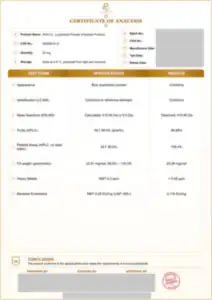
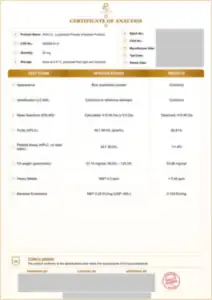
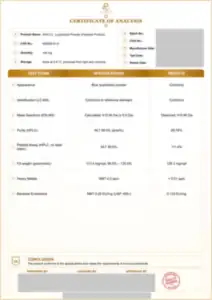
  • Lot-specific Certificate of Analysis (CoA)
  • RP-HPLC purity chromatogram
  • ESI-MS identity confirmation
  • INCI name + CAS reference
  • Recommended use level + carrier guidance
  • Stability in base formulation (aqueous serum baseline)
  • Incompatibility flag list (chelators, low-pH oxidants, etc.)
  • SDS / MSDS
  • Scalp-application compatibility (ethanol carrier, propylene-glycol carrier)
  • Suggested co-actives for hair-follicle programmes

Regulatory note

Supplied as a cosmetic-grade peptide active under the EU EC 1223/2009 cosmetic regulation, NMPA cosmetic ingredient framework, FDA OTC monograph framework (where applicable), and equivalent regimes elsewhere. NOT a finished cosmetic product. Brand registration, finished-product safety substantiation, claim documentation, and notification (CPNP for EU, equivalent registries elsewhere) remain the responsibility of the brand owner. INCI naming and CAS are supplied with the SDS that ships with every lot.

Frequently asked questions

How is AHK-Cu different from GHK-Cu in practice?

The two molecules are siblings — both copper-tripeptide complexes wrapped through histidine and the peptide backbone — but the swap of glycine for alanine at the N-terminus changes the donor geometry around the copper and the way the molecule presents itself to follicular versus dermal targets. For brand work the practical translation is straightforward: AHK-Cu earns its space on a scalp serum or hair-density product, GHK-Cu on a dermal-repair or anti-aging serum. They share the same coordination-chemistry guardrails, so a brand building a paired skin-and-scalp regimen can use both actives without conflict — just keep the carrier systems aligned (chelator-free, near-neutral pH, copper-clean water) across both SKUs so the visual cues and stability tell a consistent story on the shelf.

What's the recommended use level for AHK-Cu in a hair-regrowth serum?

Cosmetic-formulation references land scalp leave-on AHK-Cu in the 0.1–1.0% window on finished mass — a notably lower band than GHK-Cu dermal serums sit at, because the follicular distribution and the tissue depth of action shift the dose-response curve. A reasonable starting point for a daily-wear scalp serum is 0.2% with room to titrate, and a twice-weekly intensive ampoule can carry 0.5–1.0% if the marketing story justifies the colour cast and the carrier holds the coordination. Brands should request the lot-specific copper-content figure, build dye-binding into their internal shelf-life programme, and confirm that the chosen surfactant and preservative system does not quietly drag the copper off-peptide over the first eight weeks on shelf.

Can AHK-Cu be combined with minoxidil in a finished topical formulation?

Mechanistically the story is clean — minoxidil works on vasodilation and anagen extension, AHK-Cu adds a copper-signalling layer that touches different follicular pathways. The formulation reality is messier. Minoxidil lives in propylene-glycol-and-ethanol vehicles that are not friendly to a Cu(II) coordination sphere, and the pH window that keeps minoxidil in solution sits at the floor of the AHK-Cu working range. A brand pursuing a combined product should plan a proper compatibility programme: copper-content readouts at week zero, four, and twelve under refrigerated and 40 °C accelerated conditions, plus a visual-colour check at each pull, before locking the carrier for production. Our broader take on copper-peptide carriers and stability lives in the [GHK-Cu formulation guide](/journal/ghk-cu-cosmetic-formulation-guide); the same principles transfer.