
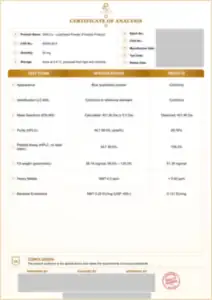
 Batch COA
Batch COA
GHK-Cu 50 mg
- Tests:
- HPLC purity · MS identity
- Source:
- Lot release certificate
Full, clear copy from sales — ask by product and strength.
Test it yourself. If it fails, you get a full refund.
Independent test fails? Full refund.
Independent test fails? Full refund.
10 vials per kit, from 1 kit per product and strength. We reply to every quote request within 24 hours. How quotes work →
10 vials per kit · from 1 kit · reply within 24 hours Quotes →
10 vials per kit · from 1 kit Quotes →
Copper(II) complex of the tripeptide Gly-His-Lys
Research topic: Skin & ageing · also listed under Hair · group: Copper peptides and GHK
GHK-Cu is the copper(II) complex of the tripeptide glycyl-L-histidyl-L-lysine (Gly-His-Lys), also listed as Copper Tripeptide-1. Supplied as lyophilized powder in sealed vials, 10 vials per kit; the batch COA of each lot reports HPLC purity, MS identity, endotoxin and fill.
The COA of every lot of GHK-Cu reports:
Ask for the COA of the batch you are quoted; the batch number on it is the batch we ship.
Each picture is the first page at low resolution, with numbers, dates and signatures covered, so the small print cannot be read. The full, clear copy comes from sales — ask for it by product and strength.
Batch COABatch COA
Full, clear copy from sales — ask by product and strength.
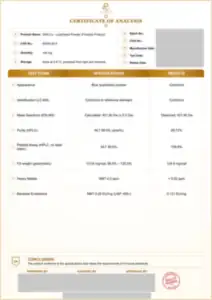 Batch COA
Batch COA
Full, clear copy from sales — ask by product and strength.
All batch COAs and test reports we show: Batch COA page.
Independent test fails? Full refund. How the refund works
| Field | Value | Source |
|---|---|---|
| Chemical name | GHK-Cu | Our product table |
| Other names | Copper Tripeptide-1 | Our product table |
| Sequence | Gly-His-Lys · Cu(II) | Our product table |
| Molecular formula | C14H22CuN6O4 | Our product table |
| Molecular weight | 401.91 g/mol1:1 copper(II) complex, as the formula shown | Our product table |
| CAS number | 89030-95-5 | Our product table |
| Strengths (per vial) | 50 mg, 100 mg | Our product table |
| Kit and minimum order | 10 vials per kit · from 1 kit per strength | Our product table |
| Form | Lyophilized powder | Our product table |
| Catalogue codes | 50 mg: CU50 · 100 mg: CU100 | Our product table |
| Purity specification | ≥ 99.0% (HPLC)Specification; the measured value is on the COA of the lot. | Our product table |
| Appearance | Blue lyophilized powder | Our product table |
| Storage | Refrigerated, protect from light | Our product table |
| Batch COA | HPLC purity · MS identity · endotoxin · fill — every lot | Our batch COA |
Product-table values checked 2026-10-09. The measured values of a lot are on its COA.
| First author / trial | Year | Journal | What was studied | Record |
|---|---|---|---|---|
| Pickart L | 1980 | Nature | The plasma tripeptide GHK and the uptake of copper into cells | PubMed 7453802 |
| Pickart L | 2015 | Biomed Res Int | Review of GHK and the cellular pathways of skin regeneration | PubMed 26236730 |
| Pickart L | 2018 | Int J Mol Sci | Review of GHK-Cu read against gene-expression data | PubMed 29986520 |
Studies recorded in our product data (checked 2026-10-09). They show what has been researched with this molecule — the materials and models of each study — and are not a statement about the vials we supply.
PubMed records checked 2026-10-07. Cited for identification only.
What to put in your quote request
With these facts the first reply can carry the unit price per kit, shipping and lead time.
Use GHK-Cu or Copper Tripeptide-1 with the CAS and the strength in mg shown on this page. The quotation and the batch COA carry the same name and the lot number.
Each stocked strength shown on this page comes as a kit of 10 sealed vials of lyophilized powder. The minimum order is 1 kit per strength, and one order can combine several strengths.
One kit is 10 vials of the same product at the same strength. Each vial holds the stated amount, for example 10 mg of lyophilized peptide; the few solutions are stated per vial in mg or ml. 1 kit per product and strength. One order can combine several products and strengths, each from 1 kit.
HPLC purity, MS identity, endotoxin and fill, on the COA of every lot of a stocked peptide. The COA carries the lot number, so you can match it to the vials you receive. Yes. Ask for the COA of the batch you are quoted; the batch number on that COA is the batch we ship.
In writing, per request. Prices are tiered by the number of kits of each peptide and strength; the quotation gives the unit price per kit, the shipping cost and the lead time. We reply within 24 hours.
Because listings describe different forms: a free peptide or a salt (acetate, TFA), a copper complex or its free peptide, one peptide or a two-peptide material — and some registries keep older numbers. Each product page says which form its values refer to; the COA of the lot is the reference.
Related peptides