On GHK-Cu. Read →

Pepoderma

Snap-8

Acetyl octapeptide-3 · cosmetic peptide

≥ 99.0%CAS 868844-74-0Anti-Aging

Overview

On the INCI deck this active reads as Acetyl Octapeptide-3 — the eight-residue, N-acetylated peptide that extends Argireline (Acetyl Hexapeptide-3) by two residues onto the SNAP-25 mimetic surface. The sequence Ac-Glu-Glu-Met-Gln-Arg-Arg-NH-CH(COOH)-CH(CH3) was designed to occupy more of the SNARE-binding face, working on the hypothesis that a longer mimetic competes more efficiently for SNAP-25 incorporation in vitro. For a finished-product brand the marketing translation is the expression-line story — forehead, glabellar, periocular — delivered in serums and creams that need to feel weightless under primer. Pepoderma writes the Snap-8 spec for indie founders and cosmetic chemists building expression-line serums, eye creams, and pre-makeup smoothing primers. Use level lands in the 5–10% window on finished-product mass; most brands settle near 5–8% once cost, sensory feel, and stack interactions are weighed. The active drops into the water phase cool and late on copper-clean process water; carriers built on polyglyceryl, lecithin, or sucrose-ester emulsifiers at neutral pH (5.5–7.0) behave well. Pre-dissolve the powder in a small glycerin or propanediol slurry before bringing it to the main batch to avoid clumping at high loadings, and keep in mind that above 5% the active becomes a meaningful share of finished-product COGS — the marketing claim and the use level need to line up before scaling. Sample fills of 10 mg and 100 mg cover bench iterations and pilot work; kilo-scale lots run on the standard OEM cycle once a carrier is locked. Snap-8 stacks naturally with Matrixyl and GHK-Cu in multi-active serums; the three address distinct dermal-aging mechanisms rather than redundant ones.

Who buys this, and why

Anti-aging peptide actives — Copper Tripeptide-1 (GHK-Cu), Acetyl Octapeptide-3 (SNAP-8), Palmitoyl Pentapeptide-4 (Matrixyl) — ship primarily to indie beauty brand founders building retail serums, established skincare R&D chemists extending an existing anti-wrinkle line, and med-aesthetic brand OEMs developing back-bar retail products. The defining formulation considerations are use-level optimisation (lower is often better at the working pH), carrier selection (aqueous vs. lipid-encapsulated), and chelator-free preservative systems. The data packet ships with guidance on all three on the lot report.

Primary buyer fit: medical-aesthetic brand R&D + back-bar retail OEM and regional cosmetic-active distributors serving brand programmes.

Specifications

CAS
868844-74-0
Purity (HPLC)
≥ 99.0%
Common vial sizes
10 mg, 100 mg
MOQ
On request (kilo-scale available)
Lead time
10–18 days
Storage
Refrigerated, protect from light

Documentation available on request

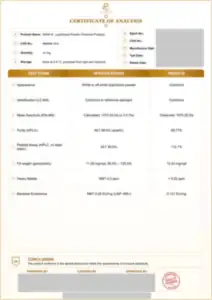
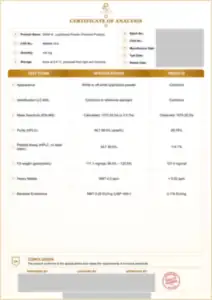
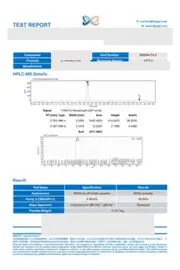
  • Lot-specific Certificate of Analysis (CoA)
  • RP-HPLC purity chromatogram
  • ESI-MS identity confirmation
  • INCI name + CAS reference
  • Recommended use level + carrier guidance
  • Stability in base formulation (aqueous serum baseline)
  • Incompatibility flag list (chelators, low-pH oxidants, etc.)
  • SDS / MSDS
  • Photo-degradation note for the active
  • Reconstitution guidance (BAC water / glycerin / lipid-encapsulated)

Regulatory note

Supplied as a cosmetic-grade peptide active under the EU EC 1223/2009 cosmetic regulation, NMPA cosmetic ingredient framework, FDA OTC monograph framework (where applicable), and equivalent regimes elsewhere. NOT a finished cosmetic product. Brand registration, finished-product safety substantiation, claim documentation, and notification (CPNP for EU, equivalent registries elsewhere) remain the responsibility of the brand owner. INCI naming and CAS are supplied with the SDS that ships with every lot.

Frequently asked questions

How does Snap-8 differ from Argireline (Acetyl Hexapeptide-3)?

Snap-8 carries two extra residues on the C-terminal end of the Argireline scaffold, extending the SNAP-25 mimetic surface that the molecule was designed to occupy. Marketing copy in the category sometimes reads this as evidence of a stronger or longer-lasting topical effect, but the peer-reviewed comparison is thinner than the positioning would suggest — both peptides typically land at 5–10% use level in serums and creams, and the choice between them is often a brand-narrative call rather than a chemistry one. Practical bench differences (stability, carrier compatibility, sensory behaviour) are largely the same, so a chemist evaluating both for a new line can scope the decision around the brand story, the pricing model, and what the formulator's preservation system already supports rather than a meaningful efficacy gap.

What's the recommended use level for Snap-8 in finished cosmetic products?

The cosmetic-formulation window sits at 3–10% on finished-product mass, with most launches landing in the 5–8% band. The dose-response curve flattens above 10% because the rate-limiting step in a topical product is peptide partitioning across the stratum corneum, not in vitro receptor occupancy — pushing the load higher adds cost without an equivalent return on the claim. The cost dynamic deserves its own line in the brief: at typical bulk pricing Snap-8 becomes a meaningful share of finished-product COGS once the use level passes 5%, so a brand running a small-batch cost model should sense-check the chosen percentage against the retail price point before locking the formula and the marketing claim together.

What stability and storage considerations apply to Snap-8 in finished products?

Dry lyophilized Snap-8 holds to a 24-month re-test window under refrigerated, light-protected storage. In a finished product the stability story shifts onto the carrier: aqueous serums at neutral pH (5.5–7.0) hold the peptide well, while emulsions and high-water-activity creams need a tight preservation strategy because cosmetic peptides do not self-preserve and a microbial issue will compromise the entire active stack, not just Snap-8. For brands taking the active into a new carrier system, scoping a carrier-specific stability programme — t-zero, four-week, twelve-week, and twenty-six-week pulls under refrigerated and 40 °C accelerated conditions — gives the launch dossier the data it needs and avoids a post-shipment surprise three months in.